
Posted On July 10, 2026
Buying Hospital Management Software isn’t just a technology decision anymore—it’s an operational one. The right platform should help hospitals reduce administrative work, improve coordination between departments, and support better patient care. The wrong one can create more complexity than it solves.
Before comparing feature lists or requesting product demos, it’s worth understanding which capabilities will actually make a difference to the way your hospital operates.
Hospital software demonstrations are designed to impress.
Everything looks quick.
Every workflow appears simple.
Every dashboard promises complete visibility.
Then the system goes live.
That’s usually when the real questions begin.
Good Hospital Management Software isn’t measured by what happens during a demo.
It’s measured by what happens on an ordinary Tuesday morning when every department is busy.
One of the quickest ways to create confusion is by storing patient information across multiple systems.
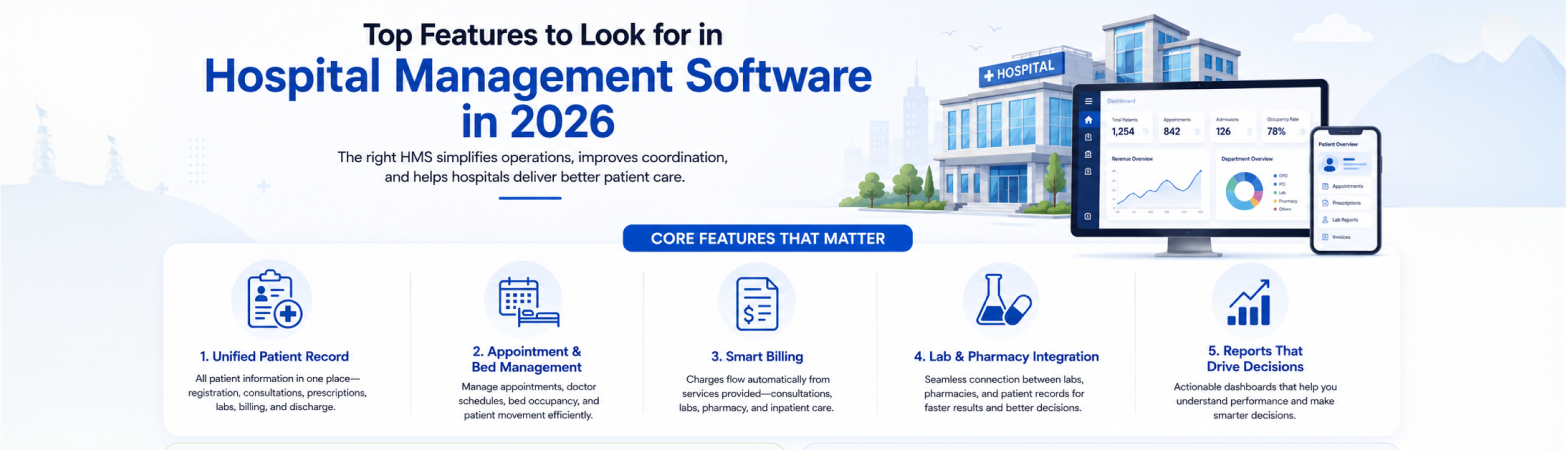
A good HMS keeps registration details, consultation notes, prescriptions, investigations, billing, and discharge information connected so every authorized department works from the same record.
Scheduling isn’t just about booking appointments.
Hospitals also need visibility into doctor availability, bed occupancy, and patient movement.
The right system helps teams plan resources instead of reacting to bottlenecks throughout the day.
Billing should never feel like a separate process.
Whether it’s consultations, diagnostics, pharmacy purchases, or inpatient care, charges should flow naturally from the care that’s been delivered rather than being entered manually afterwards.
Doctors shouldn’t need to switch between multiple systems just to review test results or confirm medications.
Connecting laboratories, pharmacies, and patient records reduces duplicate work and helps information reach the right people more quickly.
Every HMS includes reports.
The useful ones help answer practical questions.
Good reporting supports better decisions instead of producing more spreadsheets.
One of the biggest mistakes hospitals make is focusing only on today’s requirements.
A platform may work well for a 50-bed facility.
Scalability isn’t always exciting during procurement.
It becomes crucial a few years later.
Cloud-based platforms and modular architectures are becoming increasingly common because they allow hospitals to expand without rebuilding everything from scratch.
Implementation isn’t the finish line.
It’s the beginning.
The best Hospital Management Software continues to evolve alongside the organisation using it.
Healthcare regulations change.
Patient expectations change.
Technology changes.
Your software should be able to adapt without forcing the hospital through another major transformation every few years.
Choosing the right technology partner is often just as important as choosing the platform itself.
The best Hospital Management Software isn’t the one with the longest feature list.
It’s the one that quietly makes everyday work easier—for clinicians, administrators, and patients alike.
If your teams spend less time navigating systems and more time delivering care, the technology is doing its job.
At smartPerfect.ai, we build hospital management solutions designed around real healthcare workflows. From patient registration and EMRs to billing, laboratory integration, and analytics, our platforms are built to help healthcare organisations improve efficiency today while preparing for the future of digital healthcare.
Hospital Management Software (HMS) is a digital platform that helps hospitals manage patient records, appointments, billing, laboratory services, pharmacy operations, and administrative workflows through a single system.
Some of the most valuable features include integrated patient records, appointment scheduling, billing, laboratory and pharmacy integration, reporting dashboards, and secure role-based access.
For many hospitals, cloud-based systems offer easier maintenance, automatic updates, and greater scalability. The right choice, however, depends on organisational requirements, infrastructure, and regulatory considerations.
Yes. Modern HMS platforms are typically designed to integrate with EMRs, laboratory systems, pharmacy software, billing applications, and other healthcare technologies, reducing duplicate data entry and improving operational efficiency.
Rather than choosing the platform with the most features, hospitals should evaluate how well the software supports their workflows, scales with future growth, and integrates with the systems they already use.